




Imagine the director of a training academy asks you to explain a drop in course completion before tomorrow’s meeting. You have an enrollment spreadsheet, support tickets and a screenshot of the dashboard. An assistant can summarize each source in a paragraph. The director needs a deliverable that answers a harder question. Does the spreadsheet count learners who started the course while the dashboard counts everyone who enrolled? Are the complaints concentrated in one lesson? A small error in the denominator can change the conclusion, however polished the slides look.
That distinction helps explain OpenAI’s November 17, 2026 release. GPT-6.2 Astra is designed for projects that require judgment across multiple sources and constraints. GPT-6.2 Sol is designed for everyday work at higher volume. Both can write code and use tools. Choosing between them means looking at a representative task, its deadline and what it costs to review the result. The figures below come from published documentation and evaluations. The examples show how the models could be used in practice.
OpenAI launch and benchmarks · OpenAI API changelog
The short answer. Astra and Sol share a 1.05-million-token context window. At standard API rates, Astra costs $8 for input and $40 for output per million tokens. Sol costs $2 and $10 respectively. Start with Sol for recurring requests and test Astra when the work calls for a series of related decisions and a deliverable someone else can verify.
What’s new in Astra? From source material to a reviewable deliverable
The most consequential changes show up in the final stage of a project. OpenAI reports improvements in following presentation, spreadsheet and document templates, and in designing interactive interfaces. Consider a monthly presentation. The indicators need to stay in a familiar order, a headline needs updating when the figures point to a different conclusion, and an exception needs to appear next to the chart it qualifies. That lets readers check the finding in the deck itself.
In the academy example, give Astra the previous presentation and ask it to revise three slides. Define “completion” and ask it to trace every percentage back to a row in the source. If it cannot explain the decline for a particular cohort, “Cohort start date unavailable” is useful information for the director. Then change one number in the input sheet and check the cell, headline and chart together. That small test reveals whether the team can update the deliverable again next month.
The release also shows an advance in three-dimensional design. In one OpenAI demonstration, the curved balconies of Chicago’s Marina City towers inspired a paper lamp. The project moved from reference photos to revisions in computer-aided design software, then to a lamp assembled by hand. The photo became a set of design choices that could be checked in a physical object. For a similar project, ask which parts must be assembled first, what happens if the base diameter changes, and which dimensions were inferred from the reference.

Editorial illustration of a designer assembling a paper lamp beside a 3D model
What’s new in Sol? Where it comes close to Astra
Sol retains GPT-6.1 Sol’s price while improving on some multi-step workloads. Its score rose 5.3 percentage points over its predecessor in OpenAI’s internal GDPval v2 evaluation. In FrontierCode 2.0, which measures whether changes to real repositories meet maintainers’ standards, Sol was within half a point of Astra at maximum effort and cost about one-fifth as much in that test. It is a specific example of a narrow performance gap alongside a substantial cost difference.
Consider a team that handles learner requests every morning. A message might include a problem description, lesson number and refund request. Sol can extract the lesson number, categorize the issue and draft a response grounded in a specific section of the academy’s policy. Separate the output into fields so that refund requests can go to the staff member authorized to handle them. A disagreement between the date in the message and the date in the system warrants closer review. This frees the team to spend more time on cases that require judgment.
Eight practical changes in GPT-6.2
Lower Astra rates. Input fell from $10 to $8 per million tokens and output fell from $50 to $40. Reading cached input dropped from $1 to $0.40. Existing integrations may see a difference before accounting for changes in quality or response length.
The same Sol rates with a new performance profile. Sol retains its predecessor’s base prices. Teams can move part of their workload to the new model and track acceptance and spending against the same price schedule.
Closer adherence to document templates. OpenAI describes improvements in turning several references into a presentation or spreadsheet ready for review. Check formulas, section order and whether someone else can update the file later.
Fewer output tokens on some workloads. In OpenAI’s internal GDPval v2 evaluation, the new Astra improved its score while using 22% fewer output tokens than GPT-6 Astra. Use your actual token counts to estimate the effect in production.
Lower costs for comparable scores on one coding test. In Cognition’s Codex runs, Sol came within 0.4 percentage points of Astra in FrontierCode 2.0, at a lower average cost.
More precise work in design software. OpenAI showed examples of written specifications becoming 3D models or simulations. Ask for the editable project and its inputs so an engineer can inspect and revise the assumptions.
Paid acceleration. Both models support Ultrafast in the API. A faster service tier can help when a customer is waiting or a developer is iterating on a change. Reports scheduled for later review can use batch processing.
Background completion windows. The Responses API public beta added two-hour and eight-hour windows at discounts of 30% and 40% off standard model-token rates, respectively. Reserve these for workloads with flexible deadlines.
OpenAI launch and benchmarks · OpenAI API changelog · Cognition FrontierCode 2.0 leaderboard
Technical specifications and what they mean for Arabic workflows
Specification | GPT-6.2 Astra | GPT-6.2 Sol |
|---|---|---|
API model ID |
|
|
Context window | 1,050,000 tokens | 1,050,000 tokens |
Maximum input / output | 922,000 / 128,000 tokens | 922,000 / 128,000 tokens |
Native inputs and output | Text and images in, text out | Text and images in, text out |
Published knowledge cutoff | May 18, 2026 | June 1, 2026 |
Standard input / output per million tokens | $8 / $40 | $2 / $10 |
Cached input reads per million tokens | $0.40 | $0.10 |
Astra API model card · Sol API model card
The context window is the space available for the request and its associated response and reasoning. Tokens are units of text whose size depends on the content, so a million tokens does not translate to a fixed number of pages in Arabic. The shared capacity lets both models handle large files. To see how well they use that capacity, plant a known exception in an appendix and ask for the page number, the passage and the table it affects.
Both models support function calling and structured outputs. With the relevant tools enabled in the Responses API, they can search the web or files and interact with a computer. The distinction matters when analyzing a photographed invoice or preparing an article about a recent release. Reading the invoice image is native. Checking a price posted today requires access to a current source. Generating an image uses a separate tool. For bilingual files, check the display order of headings, mixed Arabic and Latin text and reference numbers after transferring content between editors.
Astra API model card · Sol API model card · OpenAI API changelog
Token price and the cost of a finished task
Suppose a request uses 20,000 input tokens and 2,000 billed output tokens. At standard short-context rates, with no cache or tool fees, Astra costs $0.16, evenly split between input and output. The same request costs $0.04 with Sol. At a thousand requests, the totals are $160 and $40. These estimates hold token volume constant. Real workloads may require different amounts of reasoning, output or follow-up.
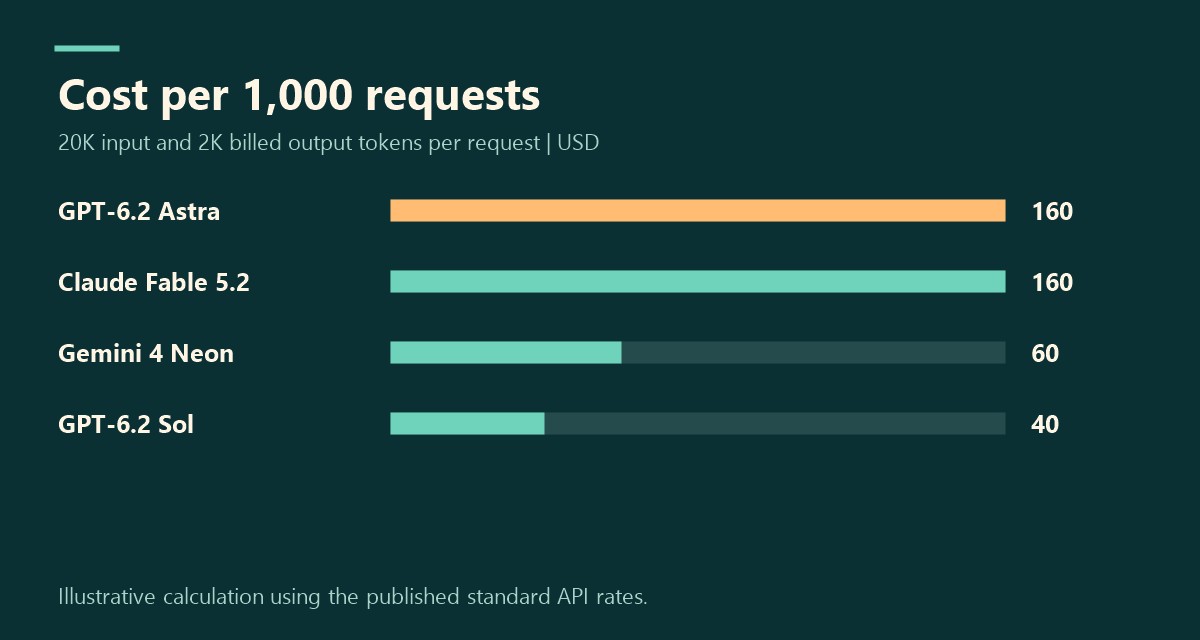
Cost per 1,000 requests at published standard API rates
Astra API model card · Sol API model card · Anthropic’s Fable 5.2 specifications and prices · Google’s Gemini 4 Neon announcement
For requests above 272,000 input tokens, Astra and Sol charge twice the standard input and caching rates and 1.5 times the output rate across the entire request. Recurring work can also qualify for discounted reads of a cached prefix. Record the size of your fixed instructions, how often the cache is reused and how many attempts it takes to get an accepted result. Those figures give you a better operating estimate than token prices alone.
Astra API model card · Sol API model card
Pricing in US dollars and Saudi riyals
The table shows API prices per million tokens, converted at 3.75 Saudi riyals per US dollar using the Saudi Central Bank’s published rate. Amounts are approximate and exclude taxes and tool fees. Application subscriptions and their usage allowances are billed separately.
Charge per million tokens | Astra, USD / SAR | Sol, USD / SAR |
|---|---|---|
Standard input | 8 / 30 | 2 / 7.50 |
Standard output | 40 / 150 | 10 / 37.50 |
Cached input reads | 0.40 / 1.50 | 0.10 / 0.375 |
Cache writes, 30-minute retention | 10 / 37.50 | 2.50 / 9.375 |
Cache writes, 12-hour retention | 20 / 75 | 5 / 18.75 |
Batch input | 4 / 15 | 1 / 3.75 |
Batch output | 20 / 75 | 5 / 18.75 |
Standard input above the long-context threshold | 16 / 60 | 4 / 15 |
Standard output above the long-context threshold | 60 / 225 | 15 / 56.25 |
The long-context rate applies to the whole request once input exceeds 272,000 tokens. With 300,000 input tokens and 10,000 output tokens, Astra costs about $5.40 or SAR 20.25. Sol costs about $1.35 or SAR 5.06. If you are sending a folder of appendices, removing irrelevant sections before submission can reduce review time as well as model usage.
When does caching pay off?
Cached reads cost 5% of normal input rates for both models. An education platform may benefit when every request starts with the same editing guidance, terminology glossary and support policy. Put that material first and add the details of the new case at the end. Compare cache reads and cache writes in your usage logs. Cache write costs and changes to the prompt prefix can affect the savings materially.
What does speed cost?
Fast costs twice the Standard rate for the same context length. OpenAI lists Ultrafast at three times Standard through February 28, 2027, and six times Standard starting March 1 in Pacific time. Measure time to first output separately from time to the complete deliverable. The first matters in a live conversation. The second matters to an editor waiting for an entire report.
Astra API model card · Sol API model card · Saudi Central Bank exchange rates
Reasoning effort and how to choose a setting
The API accepts low, medium, high, xhigh and max for both models. It rejects none. The setting changes the effort the model spends reasoning through the task. Start at medium on a new integration and measure what additional effort buys. If the problem is a missing source or a vague acceptance criterion, supply the source or clarify the criterion before changing the setting.
Astra reasoning effort | Index score | USD per task | Minutes per task |
|---|---|---|---|
low | 46 | 0.66 | 2.2 |
medium | 57 | 1.62 | 5.1 |
high | 60 | 2.07 | 6.7 |
xhigh | 62 | 2.52 | 8.1 |
max | 62 | 4.00 | 15.0 |
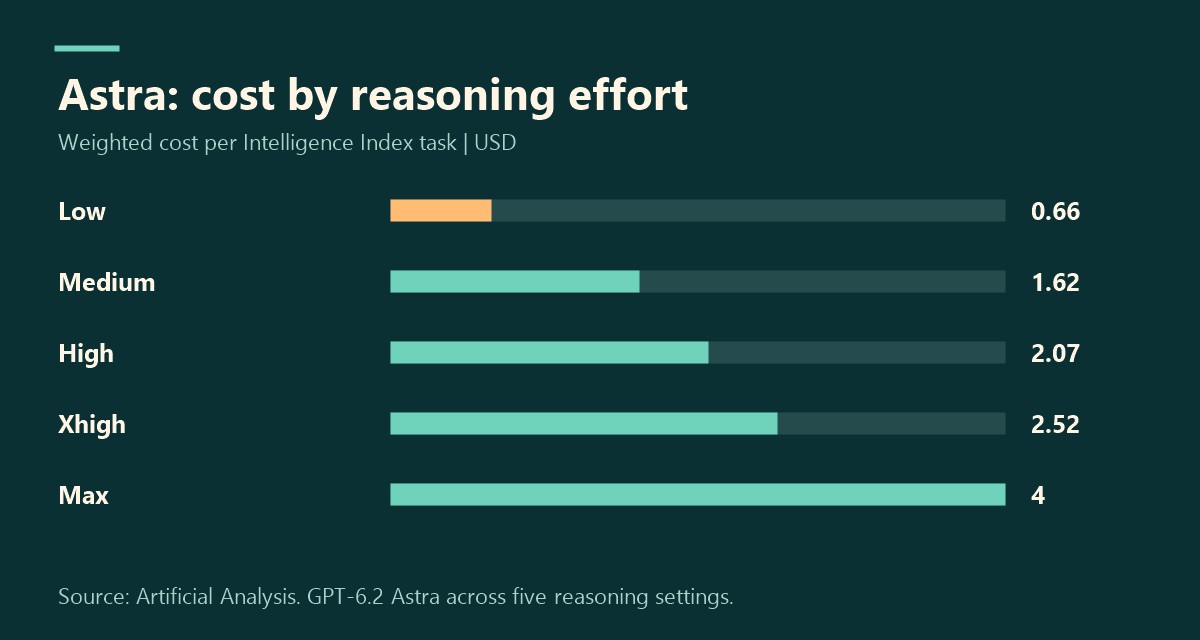
Astra task costs across five reasoning effort settings
On the aggregate Artificial Analysis index, Astra rounds to 62 at both xhigh and max, while the cost per task rises from $2.52 to $4.00. Individual benchmarks can move in a different direction. In the published FrontierCode-AA 2.0 comparison, Astra scored about 49% at xhigh and 45.4% at max. Use repeated measurements on the deliverables your team actually needs.
OpenAI’s GPT-6.2 integration guide · Artificial Analysis comparison by effort
Choosing within the OpenAI lineup
Model | USD per million tokens, input / output | Where to try it |
|---|---|---|
GPT-6 Astra | 10 / 50 | Baseline for upgrading a complex existing workflow. |
GPT-6.2 Astra | 8 / 40 | Combine several files and check how the numbers support a recommendation. |
GPT-6.1 Sol and GPT-6.2 Sol | 2 / 10 | Compare releases on recurring support tickets at the same base rates. |
GPT-6.1 Terra | 1 / 5 | Test screen-reading and writing tasks that need a fast response. |
GPT-6 Luna | 0.10 / 0.50 | Classify large batches of titles into well-defined categories. |
OpenAI model lineup · GPT-6 Astra model card · OpenAI launch and benchmarks
An upgrade from GPT-6 Astra brings lower standard rates and gains on some quality measures. In OpenAI’s internal professional-work evaluation, the new Astra gained 6.2 percentage points while using 22% fewer output tokens. The economics look different if you already use Luna to extract a course ID from one line. Review a sample of errors and count how many require broader context. Routing that subset to Sol may cost less than upgrading every request.
OpenAI launch and benchmarks · OpenAI model lineup
Benchmarks by workload
Coding in real repositories
Cognition reports FrontierCode 2.0 scores alongside average task costs. The leaderboard includes four OpenAI model releases running in Codex and Carbon running in Antigravity CLI. The figures reflect each complete setup, including the agent environment. Sol gained 4.2 percentage points in this test and Astra gained 0.2. Average task cost rose from $1.03 to $1.29 for Sol and fell from $6.68 to $5.97 for Astra.
Model and effort | Score | Average task cost |
|---|---|---|
GPT-6.2 Astra · max | 44.2% | $5.97 |
GPT-6 Astra · max | 44.0% | $6.68 |
GPT-6.2 Sol · max | 43.8% | $1.29 |
Gemini 4 Carbon · high | 42.6% | $5.06 |
GPT-6.1 Sol · max | 39.6% | $1.03 |
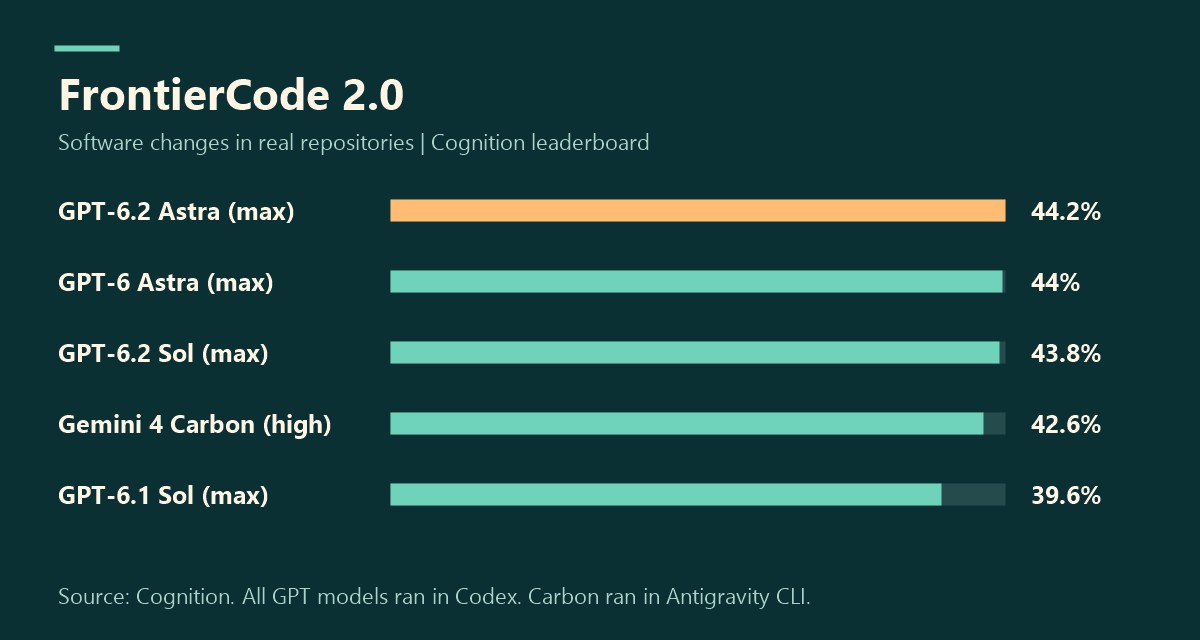
Five model configurations on Cognition FrontierCode 2.0
Use this benchmark when evaluating work that requires code changes and tests before merge. If the goal is to explain a project to a new colleague, add a sample that checks whether the model can locate the relevant configuration and explain how the components fit together. One model may fix the bug while another produces a handover that is easier to review.
Professional work, automation, science and design
Benchmark | What it measures | Published result |
|---|---|---|
GDPval v2 | Professional work spanning multiple source files | Astra +6.2 points over its predecessor. Sol +5.3 points over its predecessor. |
Agents’ Last Exam | Multi-step professional deliverables | Astra +5.2 points over its predecessor and +5.5 points over Fable 5.2 in OpenAI’s comparison. |
Terminal-Bench-Science 0.1 | Computational science tasks in a terminal | Astra 78.1% and Fable 73.3%, both at max, in Artificial Analysis. |
AutomationBench-AA | Business workflow automation | Astra 77.2% and Fable 76.4%, both at max, in Artificial Analysis. |
AA-3D | Reviewers’ preferences for interactive 3D experiences | Astra 1,318, Fable 1,271 and Sol 1,259 Elo. |
AA-3D compares preferences between interactive experiences. GDPval v2 evaluates the quality of professional deliverables on longer assignments. A model can excel at terminal-based work and fall behind on document synthesis. Percentage scores and Elo ratings answer different questions.
Some measurements also have similar names. Cognition publishes FrontierCode 2.0, while Artificial Analysis reports FrontierCode-AA 2.0 in its comparison. Include the version, environment and reasoning setting beside the number so readers can reproduce the comparison. The same principle applies to variants of Agents’ Last Exam.
OpenAI launch and benchmarks · Cognition FrontierCode 2.0 leaderboard · Artificial Analysis comparison by effort
The Artificial Analysis Intelligence Index
Model release | Best published rounded score | A question worth testing |
|---|---|---|
Claude Fable 5.2 | 65 | Does the open-ended project span several repositories? |
GPT-6.2 Astra | 62 | Can the model reconcile conflicting sources in a file a reviewer can verify? |
Gemini 4 Neon | 61 | Is the original source an audio or video recording? |
GPT-6.2 Sol | 57 | How many acceptable outputs fit into the batch budget? |
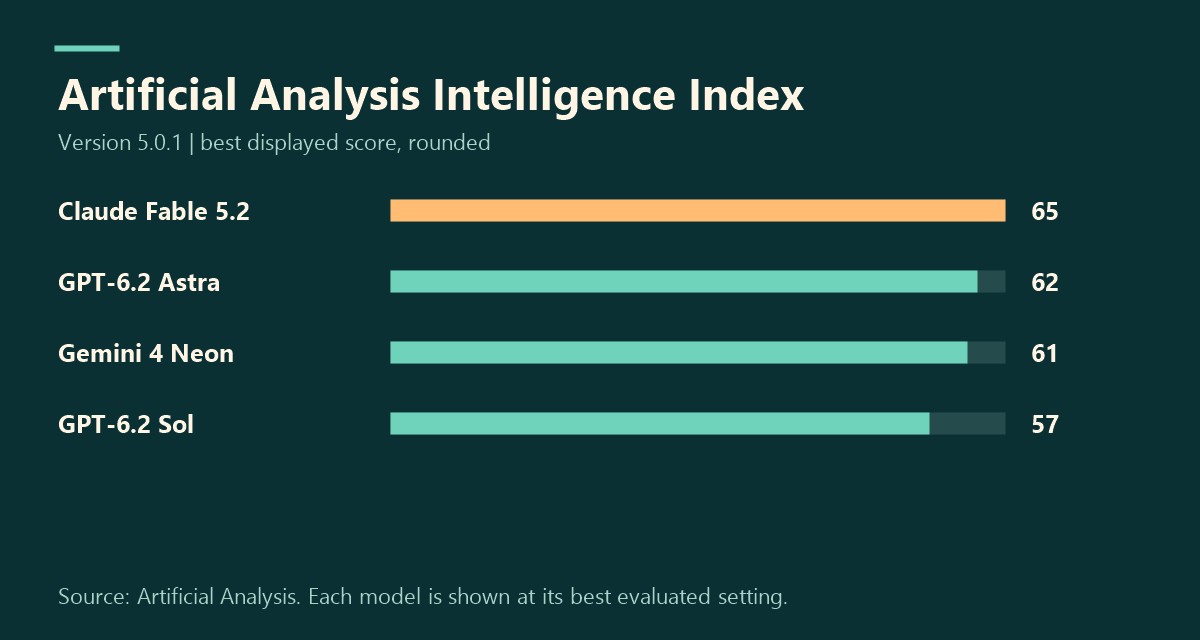
Rounded Intelligence Index scores for four models
Version 5.0.1 combines nine evaluations across office work, automation, coding, science and general reasoning. The rounded aggregate scores give a different ordering from the coding test in Codex. In an internal comparison, track whether the task was completed and whether it contained errors with serious downstream costs, such as a table linked to the wrong reference.
Artificial Analysis release leaderboard · Artificial Analysis comparison by effort
Where Gemini 4 Carbon fits
Carbon was also covered in Massaq’s guide to Claude Fable. It scored 42.6% in FrontierCode 2.0 at high in Antigravity CLI. Google lists introductory rates of $2 for input and $10 for output per million tokens through November 30, 2026, rising to $4 and $20 on December 1. Use the December price for any budget that extends beyond the offer. When testing across platforms, note which steps each agent completed and where a person had to intervene.
Google API pricing for Carbon · Cognition FrontierCode 2.0 leaderboard · Massaq’s guide to Claude Fable 5.2
How Astra and Sol compare with Anthropic and Google
Claude Fable 5.2 and open-ended software projects
Anthropic positions Fable 5.2 for demanding technical work, including changes across multiple repositories. Fable and Astra have the same base rates of $8 for input and $40 for output per million tokens. Fable charges $0.20 per million cached input reads, compared with Astra’s $0.40. If every request refers to a large, stable body of material, compare read and write costs, cache retention and the share of requests that actually hit the cache.
Anthropic’s Fable 5.2 specifications and prices · Astra API model card
OpenAI reports that Astra beat Fable by 5.5 points on Agents’ Last Exam at 5% of Fable’s cost in that evaluation. It notes that the leaderboard excluded nine Fable tasks that ran on a fallback model. Treat the figure as specific to that benchmark. To assess your own software project, give both models the same change request and identical repository snapshots. Calculate the cost of a change that passes tests and earns the reviewer’s approval.
OpenAI launch and benchmarks · Anthropic’s Fable 5.2 specifications and prices
Gemini 4 Neon and direct audio and video input
Google announced Neon on November 18, a day after OpenAI’s release. Google lists standard API rates of $3 for input and $15 for output per million tokens and a one-million-token context window. Neon can combine documents, charts, audio and video in one context. A training team trying to identify when an instructor explains a chart can try the original recording with Neon. With Astra or Sol, prepare a timestamped transcript and a relevant set of stills, since both models accept text and images natively.
Google’s Gemini 4 Neon announcement · Astra API model card · Sol API model card
When you already have a transcript and still images, focus directly on attribution and accuracy. Did the model attach the statement to the correct speaker? Did it distinguish what the slide showed from what the instructor said aloud? Did it follow the Arabic terminology used in the course? Choose a clip with known transcript errors and hide the model name from the reviewer. That helps isolate differences in how the models interpret the material and in the quality of the inputs each received.
For a closer look at direct audio and video input, our Gemini 4 Neon guide explains how to review timestamps and compare what an instructor said with what appeared on screen.
What to verify before accepting a result
A model can sometimes produce a plausible answer with a source file missing. OpenAI reported that in two evaluations the new models were more likely to omit blockers, such as a missing file or unavailable search tool. It said additional instructions in Codex reduced that behavior. In the academy example, one missing cohort table could lead to a confident explanation of a trend that never occurred. Ask the report to list the files reviewed, the periods they cover and the cells that could not be calculated. Check a sample of references before sending it to management.
OpenAI launch and benchmarks · GPT-6.2 system card
To compare the models for an Arabic-speaking team, collect 20 real tasks from the past month. Include routine queries, cases that require both a document and an image, and a case with a critical reference missing. Keep instructions, tools and deliverable templates fixed. Record time to an accepted result, revisions, cost, and accuracy of language and numbers. Count invented sources as material errors even if the writing is polished. Use the results to pick a default model and define which cases to escalate.
Operational limits to test
Output budget. Reasoning tokens count toward billed output and can reduce the space available for the response. Leave room for the final document and watch for incomplete results.
Image reading. Test small figures, axis labels and stamps against known samples. A single misread number can still lead to an apparently coherent conclusion.
Product and API settings. The technical limits in this guide refer to the API. In ChatGPT Work or Codex, check tool permissions, plan allowances and access to faster service tiers.
Tool availability and permissions. Reading, editing and sending can have separate permissions. If the model drafts customer support replies, make sending an explicit step so reviewers can assess the draft independently.
Run configuration. Provider and independent evaluations depend on the tools, data and reasoning settings. Record these when repeating the evaluation in your organization.
Getting started in ChatGPT Work, Codex and the API
At launch, OpenAI announced access in ChatGPT Work and Codex for Plus, Pro, Enterprise and Edu users. Some options, including eligible Ultrafast access in Enterprise and Edu, depend on the workspace administrator enabling them. Developers can select the model and reasoning effort in the Responses API and enable tools as needed. The example runs the same task against both models and prints usage alongside their answers.
from openai import OpenAI

client = OpenAI()
models = ("gpt-6.2-sol", "gpt-6.2-astra")
brief = (
    "Draft a review plan for a course completion report. "
    "Specify three checks for the denominator and list the data "
    "you need before explaining the decline."
)

for model in models:
    response = client.responses.create(
        model=model,
        reasoning={"effort": "medium"},
        input=brief,
        max_output_tokens=4000,
    )
    print(model, response.status, response.usage)
    print(response.output_text)
When upgrading an existing integration, look for settings that use none and track latency and errors on a small sample. In extended conversations, OpenAI recommends keeping the prompt prefix stable and appending instructions. This supports cache reuse and helps preserve reasoning across requests.
OpenAI launch and benchmarks · OpenAI’s GPT-6.2 integration guide
Four use cases for businesses in Saudi Arabia and the Gulf
Workload | Model to try first | Acceptance criterion |
|---|---|---|
Sort bilingual support tickets | GPT-6.2 Sol | Correct category and a response grounded in the support policy. |
Build a management report from multiple files | GPT-6.2 Astra | Traceable figures and explicit assumptions. |
Extract fields from a structured record | GPT-6 Luna, with Sol for ambiguous cases | Fields match the verified reference. |
Analyze a long training recording | Gemini 4 Neon | Accurate timestamps and correctly attributed quotations. |
For the support example, consider a team that receives both Arabic and English requests, with several terms for the same product. Start with 50 previously closed tickets and hide the model name from the reviewer. Measure the proportion of accepted classifications, the accuracy of references to the refund policy and the number of tickets that still needed staff intervention. Include the actual time spent editing.
If an operations director wants a dashboard built from several branches’ files, ask the model to document units, currencies and missing rows before charting any percentages. Give the reviewer an example row they can trace back to its source. If the material includes confidential data, check retention settings and connector permissions against company policy before bringing it into a test environment.
Error costs vary between an editable marketing campaign and an operations decision based on a wrong figure. Routing can reserve Astra for conflicting evidence and high-impact deliverables while assigning recurring requests to Sol. Massaq can help product teams evaluate models on their own data and connect them to the tools employees use.
Massaq AI solutions · Contact Massaq
For teams trialing either model on an existing codebase, our article on AI in software development covers reviewing generated changes, testing and maintaining code quality.
Frequently asked questions
Do Astra and Sol have the same context window?
Yes. OpenAI lists 1,050,000 tokens for both in the API, with 922,000 input tokens and 128,000 output tokens. Test how well each model finds the right evidence within the document as well as how much it can hold.
Does Sol always cost one-quarter as much?
Astra’s equivalent standard token rates are four times Sol’s. The ratio for a completed task changes with reasoning usage, cached input, tool calls and attempts required for acceptance.
Can the models take audio and video directly?
OpenAI lists text and images as the native inputs for these two models. You can prepare a timestamped transcript and still images first, or evaluate Gemini 4 Neon on the original recording.
Does increasing reasoning effort improve every task?
It depends on the benchmark. Astra’s rounded aggregate score was the same at xhigh and max, with a higher cost at max. Increase effort when your sample shows a higher acceptance rate.
Do I pay for reasoning when the displayed answer is short?
Yes. Reasoning tokens count toward billed output. Check usage reported by the API, especially when giving a high effort setting to a task with a short final answer.
How should I measure Arabic-language quality?
Use documents from your sector. Review terminology, figures and references on a sample that includes bilingual material. Mix Arabic text, Latin identifiers and dates in one table, then check reading order in the final file.
Can Astra replace Claude Fable 5.2?
That depends on the task and configuration. Astra led in OpenAI’s Agents’ Last Exam comparison, while Fable earned the higher aggregate score in the cited Artificial Analysis comparison. Try both on the same brief and record the time it takes to get an accepted deliverable.
When should I upgrade from GPT-6.1 Sol?
Run both versions on a sample of your current tasks using the same instructions and tools. Base token prices are identical. In Cognition’s benchmark, the new version scored higher and cost more per task. Evaluate the improvement after accounting for review time.
Conclusion
For the academy. Start with Sol to triage tickets and extract recurring indicators. Try Astra when management needs an explanation that reconciles conflicting definitions and a presentation the team can update later. Include Fable if the work requires an architectural change across repositories, and try Neon when decisive evidence is in a video recording. Across these cases, measure the cost of getting a deliverable its owner can verify and use.
References
OpenAI launch and benchmarks · Cognition FrontierCode 2.0 leaderboard · Artificial Analysis comparison by effort · Anthropic’s Fable 5.2 specifications and prices · Google Gemini API pricing
Specifications and rates checked on November 22, 2026. API prices are quoted in US dollars unless otherwise noted. Product subscriptions use separate pricing.