




On the day a new portal launches, its users ask a simple question. Can I complete my request? Operations asks whether the request reaches the right system and whether staff can track it. Leadership wants to know whether it reduced manual work and shortened turnaround. A project has to answer all three questions, from the moment someone hits Submit to the moment an authorized person can act.
Massaq works with organizations in Saudi Arabia to design, build and operate digital products. The value comes from connecting the user experience to the systems behind it and the information decision-makers need. This guide shows where to start when launching a platform, integrating existing systems or assessing an AI use case. It also draws on published project examples. about Massaq
Start with one task you need to improve. Identify who performs it today, where it gets stuck and how you will know after launch whether it became faster, clearer or easier to review.
Where should your project start?
The problem may be that staff switch between several applications, users cannot tell what to do next, or analysts assemble the same report by hand every month. Each symptom points to a different starting point. Pinpointing where the work slows down gives the first release a manageable scope and a testable outcome.
Problem | Where to start | A practical acceptance criterion |
|---|---|---|
The same information gets entered in several systems | Map the workflow and name the source of record | Required fields transfer and failed records are visible |
Users start an application and abandon it | Test the journey and prototype the form | Users can complete the task on a phone |
Reports disagree on how a metric is defined | Connect the data and document the metric definition | A reviewer can trace the figure to its source |
Staff review large batches of requests by hand | Pilot AI-assisted triage against a verified sample | Reviewable classifications with ambiguous cases routed for follow-up |
Digital transformation and platform development
Digitizing a process starts with understanding how it works today. For a simple service request, an employee might review two documents, check its status in another system and then notify the applicant. If those steps are scattered across files and email, adding an online form only changes where the data enters. A transformation project identifies which steps can be combined, which require a human decision and where both staff and applicants can see the status.
This is where digital transformation services and custom software development meet. Business rules become testable journeys, permissions and integrations. Identify the source of truth for each record and define what happens when an integration fails or a request is submitted twice. Before launch, walk through both a successful request and a failed one. What does the user see, what reaches operations and how does work resume after recovery?
Designing for users and operations
UI and UX design brings together how the service looks and the decisions users make along the way. Ask real users what they expect to do first, then observe where they ask for help. Test a complete Arabic screen, mixed-script fields, a failed file upload and keyboard-only completion on the web. Staff reviewing requests also need one place to see missing files and why something was returned.

Editorial illustration of a service journey review before development.
For Reinvest, Massaq designed the website and app so users could explore real estate opportunities and inspect their details in one journey. The project illustrates where design and engineering overlap. Users first discover an opportunity, then review its information and compare it with other options. See the Reinvest project for the published scope.
Data and AI in daily operations
data management and business intelligence begins with defining what the team needs to measure. A branch may count response time from initial submission, while headquarters starts the clock after all documents arrive. Both measures can be valid when they answer different questions. Give each metric a clear definition, reporting period and source, and handle missing or duplicate records before aggregation.
For artificial intelligence solutions, start with a narrow task such as categorizing support requests or extracting fields from recurring attachments. Use a sample your team has already reviewed and require the output to cite the evidence behind each decision. Measure cost per accepted record. A model may shorten reading time and still increase review time, which an end-to-end measure will catch. the Ain platform illustrates a separate use case where monitoring and operational intelligence meet.
How to measure impact before scaling
Consider a worked example. A team handles 100 requests at an average of 12 minutes each. After trialing a workflow that prepopulates recurring fields, each request averages seven minutes including review. Total processing time moves from 20 hours to 11 hours and 40 minutes. The difference is illustrative until a real sample, including difficult cases, confirms it.
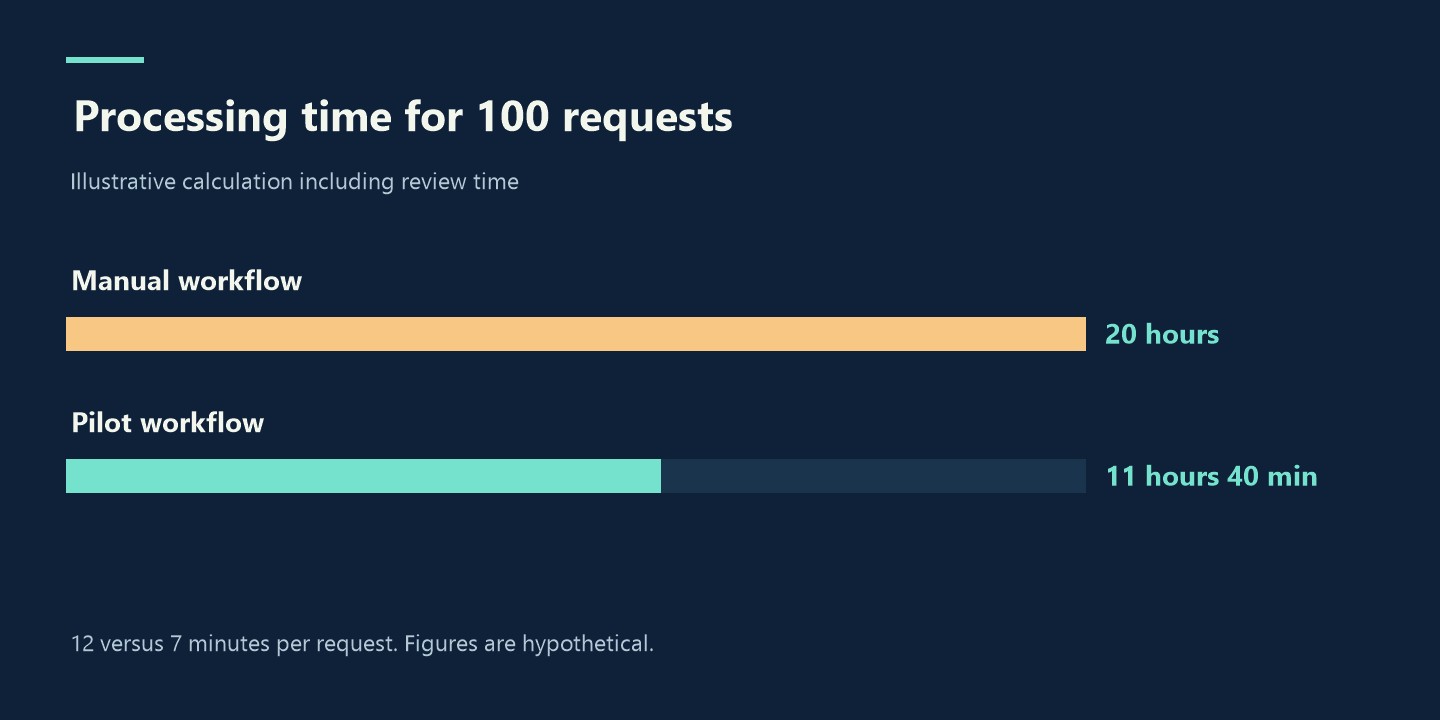
Illustrative processing time for 100 requests. These are hypothetical values, not client results.
In the actual pilot, count rework, data-transfer errors and staff time after the first output appears. Record quality before and after the trial so you can see whether any time savings came at the expense of accuracy. As usage expands, include peak-hour response time and the proportion of cases that still require manual intervention.
Training, events and platforms under pressure
An in-person event and a virtual hackathon both need a clear participant journey. It starts with registration and can include team assignment, file submissions and publication of results. Organizers need to see delayed steps and missed notifications, while support teams need a way to handle last-minute registrations. education and training services face related questions about access to materials, progress tracking and content updates.
For the 2026 Municipal Innovation Hackathon platform, Massaq’s scope ran from requirements and user experience through server setup. It covered participant and team registration, virtual rooms, attendance tracking and project uploads. The project shows how event stages connect through one platform and what organizers need to see from first registration to final submission.
Digital marketing is part of the product experience
A visitor who reaches a service page from search should quickly understand who the service is for, what it covers and where to find a documented example. They may continue to a case study or start a conversation about a specific requirement. search visibility services bring together content, technical structure and internal links. Visits and qualified inquiries then show whether the page helps readers take the next step.
Give each page a clear job. A service page explains scope. A case study shows what was delivered. An article answers questions that come before a purchase decision. With contextual links between them, readers can move to the level of detail they need and the team can measure the journey from reading to inquiry.
From defining the problem to supporting launch
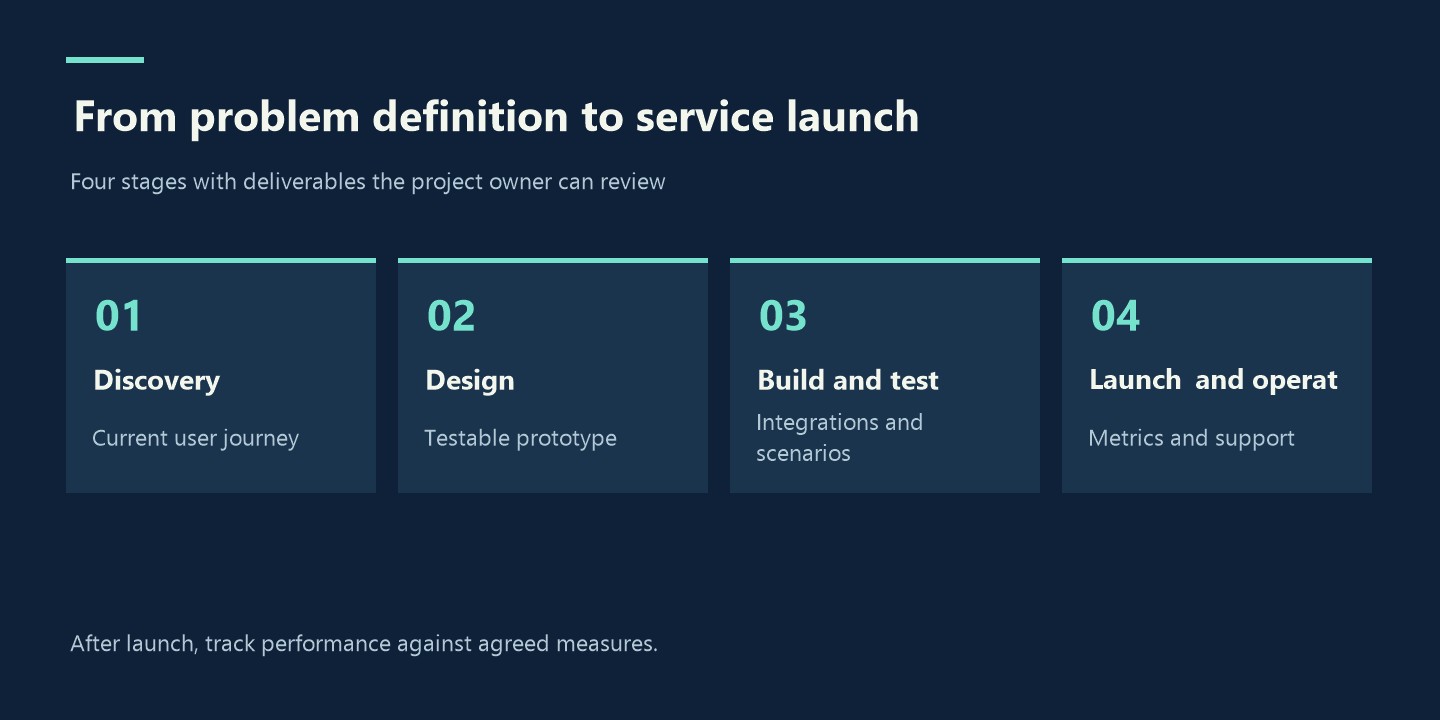
A project map showing what each stage delivers, from problem definition to performance monitoring.
Stage | Reviewable outputs |
|---|---|
Discovery | Current journey, priorities and decision owner |
Design | Prototype and acceptance scenarios in Arabic and English |
Build and test | Documented integrations with success and failure scenarios |
Launch and operation | Launch plan, operating metrics and support and improvement process |
At the outset we need to understand the audience, connected systems and any deadline set by a campaign, event or operational cycle. That information helps define the first journey to ship. At the end of each stage, the product owner should be able to review a tangible decision, prototype or test result. Once usage data is available, the team can prioritize improvements based on how people actually use the service.
Hosting and operations after launch
Operations planning begins before launch. The team should know who receives incident alerts and how to distinguish a failed external integration from a user input error. Agree on the journeys to monitor, such as completing registration or handing a new request to a back-office system. Check backup, restoration and support access before people depend on the service in their daily work.
Separate measurements make a phased rollout easier to interpret. Page load time measures something different from request resolution time. An interface can load quickly while cases accumulate in a review queue. Assign each metric to someone who can act on it. Link support reports to the application version, device and step where the issue occurred so the team can reproduce it.
Explore Massaq’s server management and security testing services and our article on building high-performance web applications that scale.
How to choose the first release scope
If the project starts with a long list of features, group them by whether they help someone complete the journey. Prepopulating application details or allowing users to resume later may be essential to launch. Some display refinements can be scheduled after collecting usage feedback. Describe the first release as an outcome. For example, an applicant can submit information, attach documents and track status on a phone. Tie engineering work to that outcome.
The estimate depends on the size of the journey, number of integrations, data quality, bilingual requirements and work needed for testing and operations. When an integration crosses departments, identify who approves each field’s definition and who can change the process. If an external system is unavailable during design, prepare realistic test data with both common cases and exceptions. Set aside time to verify the integration in the actual environment before launch.
During the first internal demonstration, ask the team to show two scenarios. A user submits a new request and sees confirmation. A staff member resumes an incomplete request and returns it to the applicant. The demonstration makes it clear what is ready and where the process or interface needs adjustment. Those outcomes are a stronger release signal than a tally of completed screens.
For more on implementing and reviewing changes, read The Impact of AI on Software Dev Practices.
Frequently asked questions
Can the work start from an existing system?
Yes. Start by assessing what works today, which integrations are available and what needs updating. The first release may add a new journey to an existing system or move just one step and measure its impact.
How do we know whether AI fits the task?
Start with a sample your team can judge. Define an acceptable output, include the cost of review and exceptions, and apply the same measure before and after introducing a model.
What should we bring to the first meeting?
Bring a description of the task, a sample outcome you want to improve, and the systems or deadlines that affect delivery. Non-sensitive examples are enough for the first discussion. Decide how to share real data later.
How can we compare Massaq projects?
Look for the project closest to the problem you want to solve. The useful similarity may be the audience, integration approach or number of steps in the journey, even across industries.
Start a conversation about your project
Tell us which task needs to work better, who performs it and what outcome you want to measure. We can discuss scope, the systems it needs to connect and the first result you want to review. Explore Massaq’s project portfolio, or contact Massaq to discuss your project.