



On November 9, 2026, Anthropic released Claude Fable 5.2 alongside a sibling model, Claude Mythos 5.2. The company calls them its most capable models for the most demanding technical work. What stands out is that the new model is smarter than its predecessor and 20% cheaper at the same time, which is rare in a market where "more capable" has usually meant "more expensive".
This guide covers everything you need to know about Fable 5.2: what's new, what it costs (in USD and SAR), and how it stacks up against OpenAI's GPT-6 Astra and GPT-6.1 Sol and Google's Gemini 4 Carbon. It also sets out its real strengths and weaknesses in numbers, and when it is worth the price versus when a cheaper model is the smarter call.
💡 The short answer: Claude Fable 5.2 is Anthropic's most capable widely available model, released on November 9, 2026. It costs $8 per million input tokens and $40 per million output tokens, 20% less than Fable 5.1. It has a 1M-token context window and up to 128K output tokens. It scored 65 on the independent Artificial Analysis Intelligence Index, the highest of any model rated at launch. It leads in agentic coding, long-horizon tasks and computer use, but it costs more than rivals such as GPT-6.1 Sol and Gemini 4 Carbon, and Anthropic itself still recommends Opus 5.5 for everyday work.
Claude Fable 5.2 at a glance
Item | Details |
|---|---|
Developer | Anthropic |
Release date | November 9, 2026 |
API model ID |
|
Input price | $8 per 1M tokens (about SAR 30) |
Output price | $40 per 1M tokens (about SAR 150) |
Context window | 1 million tokens |
Max output | 128K tokens |
Thinking | Always on (adaptive), depth set by five effort levels |
Speed | Up to 30% faster than Fable 5.1; Fast mode up to 2.5x faster |
Platforms | Paid Claude plans, Claude Code, Claude Platform, AWS, Google Cloud, Microsoft Azure |
Sibling model | Claude Mythos 5.2 (same model, fewer safeguards, verified organizations only) |
What is Claude Fable 5.2?
Claude Fable 5.2 is the latest release in the Fable tier, the most capable tier Anthropic offers to the public. It sits above the Opus family, which is built for everyday professional work, and above Sonnet and Haiku, which are tuned for speed and low cost. Fable is designed for tasks measured in hours rather than seconds: migrating an entire codebase, running a long security audit, carrying out multi-stage scientific research, or coordinating a team of AI agents that each tackle part of a problem.
Put simply, if Opus is the senior engineer on your team, Fable is the principal engineer you call in when everyone else is stuck. An engineer at Shopify described it as working like a staff-level engineer.
Fable 5.2 and Mythos 5.2: one model, two faces
The relationship between the two names confuses many readers. They share the same underlying model, and the only difference is the safeguards:
Fable 5.2 is available to everyone and carries stronger safeguards in cybersecurity and biology. Anthropic says plainly that these safeguards will block most cybersecurity-related tasks.
Mythos 5.2 drops those restrictions. It is available only to verified organizations through the Cyber Verification and Life Sciences Verification programs, and to Claude Enterprise customers through Claude Security. Anthropic calls it its most capable model for cybersecurity engineering.
What's new in Claude Fable 5.2: nine key upgrades
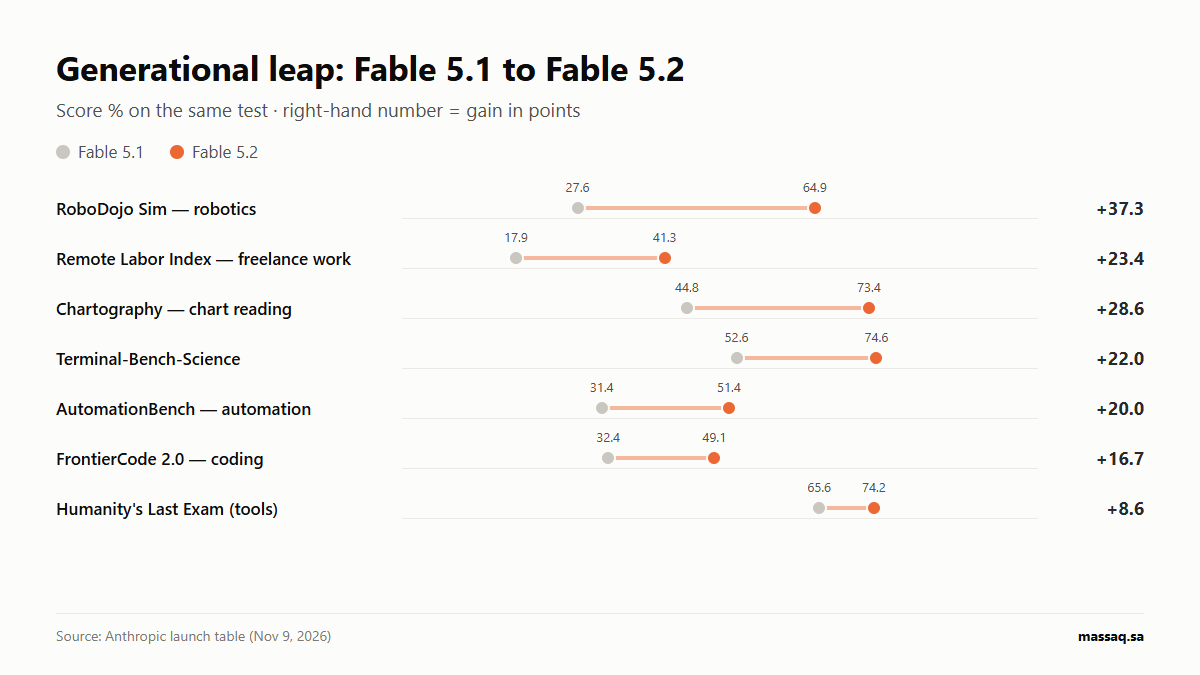
The generational leap: how much Fable 5.2 improved over Fable 5.1 on the same tests (source: Anthropic).
20% lower price: down from $10/$50 to $8/$40 per million input/output tokens, despite being more capable.
Up to 30% faster output generation than Fable 5.1.
Fast mode: up to 2.5x faster generation at $16/$80, available in Claude Code, the Claude Platform, Claude on Google Cloud and Microsoft Foundry.
Fewer tokens used: at Medium effort, the default in Claude apps and Claude Code, it uses fewer tokens than Fable 5.1 for the same work.
A leap in robotics: its RoboDojo Sim score rose from 27.6% to 64.9%, more than double. It controlled real robots on tasks such as solving a puzzle cube, unscrewing a bottle cap and drawing.
Freelance-grade work: on the Remote Labor Index it jumped from 17.9% to 41.3%. In 99 of 240 real freelance projects, its work was judged at least as good as a human professional's.
Sharper chart reading: on Chartography it rose from 44.8% to 73.4%.
Advisor and orchestrator roles: Fable 5.2 can act as an advisor that Haiku, Sonnet or Opus consult at hard decision points, or as an orchestrator that hands simpler work to cheaper models, which cuts the total cost of large projects.
Clearer communication, fewer false blocks: testers say it explains its work more clearly and admits uncertainty instead of inventing numbers it has not measured. False refusals fell by about 55% compared with Fable 5.1.
Claude Fable 5.2 pricing in detail
Language models are billed per token, a fragment of a word. A million tokens is roughly 750,000 English words. Because the Saudi riyal is pegged at 3.75 to the dollar, we have added a SAR column.
Usage type | Price (USD per 1M tokens) | Approx. SAR |
|---|---|---|
Input (standard) | $8 | SAR 30 |
Output (standard) | $40 | SAR 150 |
Fast mode input | $16 | SAR 60 |
Fast mode output | $80 | SAR 300 |
Batch API (input / output) | $4 / $20 | SAR 15 / 75 |
Cache read | $0.20 | SAR 0.75 |
Cache write (5 min / 1 hour) | $10 / $16 | SAR 37.5 / 60 |
💰 Money-saving tip: cache reads are 40x cheaper than standard input ($0.20 vs. $8). If your app sends the same instructions or documents with every request, turning on prompt caching alone can cut your bill sharply. Non-urgent jobs sent through the Batch API cost half price.
Price comparison with competitors
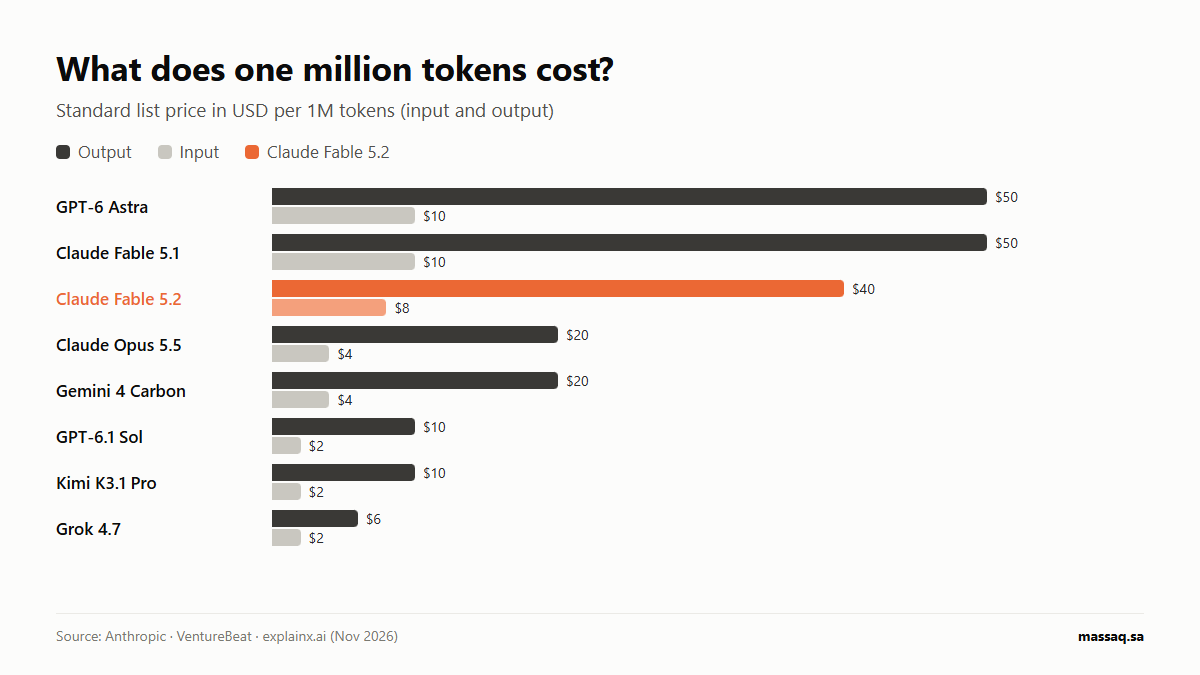
Standard list price per million input and output tokens for leading frontier models, November 2026.
Model | Company | Input ($/1M) | Output ($/1M) | Note |
|---|---|---|---|---|
Claude Fable 5.2 | Anthropic | 8 | 40 | Top score on the independent index |
Claude Fable 5.1 | Anthropic | 10 | 50 | Previous version |
Claude Opus 5.5 | Anthropic | 4 | 20 | Anthropic's pick for everyday work |
GPT-6 Astra | OpenAI | 10 | 50 | 20% pricier than Fable 5.2 |
GPT-6.1 Sol | OpenAI | 2 | 10 | Rises to $4/$15 above 272K input tokens |
Gemini 4 Carbon | Google DeepMind | 4 | 20 | $2/$10 intro price; limited availability |
Grok 4.7 | SpaceXAI | 2 | 6 | Cheapest closed model |
Kimi K3.1 Pro | Moonshot | 2 | 10 | Open weights |
DeepSeek V4.1 Flash | DeepSeek | 0.15 | 0.60 | Off-peak; doubles at peak |
Worked example: what does a single task really cost?
Take a typical job: analysing a codebase or a long contract of 200K input tokens and producing a 20K-token report, at standard prices with no caching:
Model | Input cost | Output cost | Total | SAR |
|---|---|---|---|---|
GPT-6 Astra | $2.00 | $1.00 | $3.00 | SAR 11.25 |
Claude Fable 5.2 | $1.60 | $0.80 | $2.40 | SAR 9.00 |
Claude Opus 5.5 | $0.80 | $0.40 | $1.20 | SAR 4.50 |
Gemini 4 Carbon | $0.80 | $0.40 | $1.20 | SAR 4.50 |
GPT-6.1 Sol | $0.40 | $0.20 | $0.60 | SAR 2.25 |
But note that price per token is not the real cost. A smarter model may finish the job on the first try with fewer tokens, while a cheaper one may need three attempts and a human review. What matters is cost per completed task, which the next section covers.
Effort levels: Fable 5.2's secret weapon (and hidden trap)
Thinking in Fable 5.2 is always on and cannot be switched off. You control its depth with five effort levels: low, medium, high, xhigh and max. The API default is high; Claude apps and Claude Code default to medium.
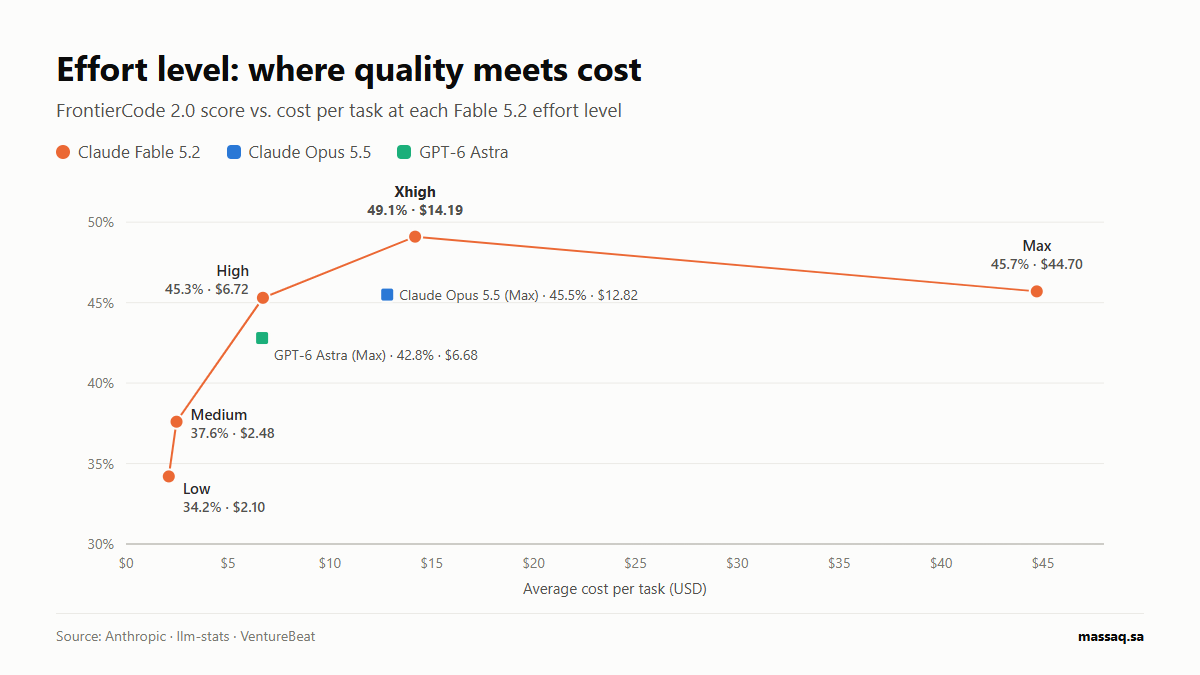
Each point is an effort level: further right costs more, higher up scores better. Max costs three times as much as xhigh and scores lower.
Effort level | FrontierCode 2.0 | Avg. cost per task | When to use it |
|---|---|---|---|
Low | 34.2% | $2.10 | Chat, classification, routine tasks |
Medium | 37.6% | $2.48 | Everyday work inside the apps |
High | 45.3% | $6.72 | Recommended starting point for serious work |
Xhigh | 49.1% | $14.19 | Complex agentic coding, once measurement proves the gain |
Max | 45.7% | $44.70 | Rarely; only to probe the model's ceiling |
Three takeaways from this table:
At high effort, Fable 5.2 roughly matches Opus 5.5's best coding score (45.5%) at about half the cost per task.
Max is an expensive trap: $44.70 per task, three times xhigh, for a lower score.
At the top levels the model may spawn subagents to review its work, a hidden cost that does not show in the per-token price.
Fable 5.2 vs. the competition: the full numbers
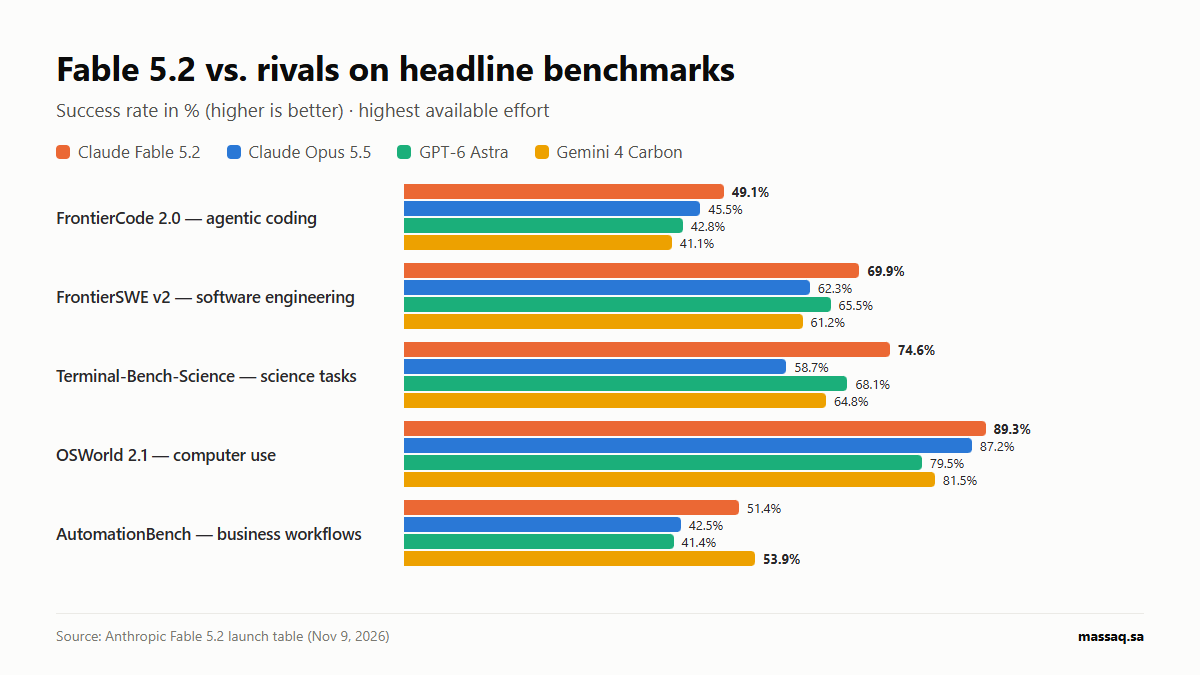
Fable 5.2 against leading rivals on five headline benchmarks (source: Anthropic's launch table).
Benchmark | Fable 5.2 | Fable 5.1 | Opus 5.5 | GPT-6 Astra | Gemini 4 Carbon |
|---|---|---|---|---|---|
FrontierCode 2.0 (agentic coding) | 49.1% | 32.4% | 45.5% | 42.8% | 41.1% |
FrontierSWE v2 (software engineering) | 69.9% | 56.3% | 62.3% | 65.5% | 61.2% |
AutomationBench (business workflows) | 51.4% | 31.4% | 42.5% | 41.4% | 53.9% |
Terminal-Bench-Science 0.1 | 74.6% | 52.6% | 58.7% | 68.1% | 64.8% |
OSWorld 2.1 (computer use) | 89.3% | 83.5% | 87.2% | 79.5% | 81.5% |
WANDR (agentic search) | 82.1% | 68.7% | 72.3% | — | — |
RoboDojo Sim (robotics) | 64.9% | 27.6% | 39.4% | 29.8% | — |
Remote Labor Index (freelance work) | 41.3% | 17.9% | 21.3% | 20.8% | — |
Humanity's Last Exam (with tools) | 74.2% | 65.6% | 67.7% | 57.2% | — |
Chartography (chart reading) | 73.4% | 44.8% | 64.4% | 71.0% | 72.5% |
AA-Briefcase v1.1 (Elo) | 1785 | 1669 | 1800 | 1569 | 1611 |
"—" means no published score. Figures come from Anthropic's launch table at the highest available effort and may differ from rivals' own launch posts.
An independent view: the Artificial Analysis index
Most of the figures above come from Anthropic itself, so an independent check matters. On the Artificial Analysis Intelligence Index (v5), Fable 5.2 scored 65, the highest of any model rated at launch and 6 points ahead of the nearest rival.
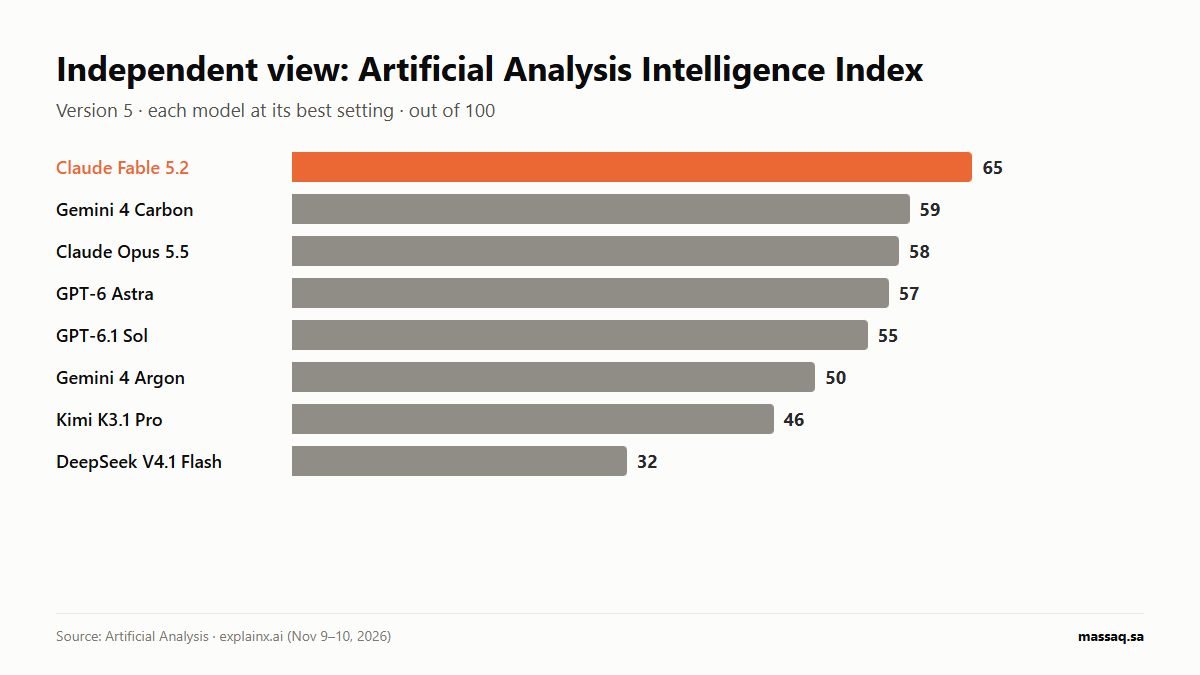
Leading models on the Artificial Analysis Intelligence Index v5 (November 2026).
The same index also shows the cost and speed side:
Setting | Index score | Cost per task | Time per task | Output speed |
|---|---|---|---|---|
Fable 5.2 (max) | 65 | $26.54 | 46.4 min | 98 tok/s |
Fable 5.2 (high) | 62 | $9.08 | 17.6 min | 92 tok/s |
Gemini 4 Carbon (high) | 60 | $7.76 | 26.5 min | 77 tok/s |
Fable 5.2 (medium) | 56 | $3.80 | 8.3 min | 86 tok/s |
GPT-6.1 Sol | 55 | $1.27 | 19.7 min | 57 tok/s |
Fable 5.2 (low) | 54 | $3.10 | 6.5 min | 92 tok/s |
Fable 5.2 vs. GPT-6 Astra
This is the clearest matchup. Fable 5.2 leads in agentic coding (49.1% vs. 42.8%), software engineering (69.9% vs. 65.5%), computer use (89.3% vs. 79.5%) and Humanity's Last Exam (74.2% vs. 57.2%). It is also 20% cheaper per token ($8/$40 vs. $10/$50). Astra edges ahead on ARC-AGI-3 (98.6% vs. 97.72%). Astra's best FrontierCode run costs $6.68 per task, almost the same as Fable at high effort ($6.72), which scores higher.
Verdict: Fable 5.2 wins on most metrics and costs less.
Fable 5.2 vs. GPT-6.1 Sol
Sol is OpenAI's value workhorse. It costs a quarter of Fable's price ($2/$10), has a 1.05M-token context window and offers a 95% discount on cached input. But it scores 55 on the Artificial Analysis index against Fable's 65. On that index Sol costs $1.27 per task versus $26.54 for Fable at max effort. Fable generates tokens faster (98 vs. 57 tokens per second) but takes longer per task at max effort because it thinks more.
Verdict: Sol for high-volume routine work, Fable for hard, high-stakes tasks where the quality gap justifies the cost.
Fable 5.2 vs. Gemini 4 Carbon
Gemini 4 Carbon is the closest rival on the independent index, at 59. It beats Fable on business-workflow automation (AutomationBench 53.9% vs. 51.4%) and costs half as much ($4/$20, with a $2/$10 intro price). Fable leads in coding, computer use and science tasks. Carbon's biggest drawback today is limited availability: reports say it is not yet open for general API use.
Verdict: Carbon is attractive for business automation if you can get access; Fable is broader and easier to obtain.
Fable 5.2 vs. Claude Opus 5.5: the in-house rivalry
In practice this is the comparison that matters most. Opus 5.5 costs exactly half as much ($4/$20), and Anthropic itself calls it the strongest model for everyday work, recommending it for most coding and knowledge work. Opus beats Fable on AA-Briefcase Elo (1800 vs. 1785) and GDPval-AA (1866 vs. 1831), and on Terminal-Bench 4.0 the gap is within noise (67.6% vs. 66.4%).
Fable pulls clearly ahead on long, complex tasks: robotics (64.9% vs. 39.4%), real freelance work (41.3% vs. 21.3%) and advanced mathematics. In a formal proof of Fermat's Last Theorem in Lean, a team of about 1,000 agents running an early Fable 5.2 snapshot finished in 30 hours, while an Opus 5.5 team completed only about a quarter.
Verdict: start with Opus 5.5 and move up to Fable 5.2 when you hit Opus's ceiling on long tasks.
Benchmark guide: every Fable 5.2 result by test type
Benchmarks are standard sets of tasks used to measure different models on equal terms. No single test tells the whole story: a model that excels at coding may fall behind in medicine. Below are all of Fable 5.2's published results, grouped by capability, with a short note on what each test measures. Each is compared with Claude Opus 5.5, its strongest in-house rival.
1. Coding and software engineering
Benchmark | What it measures | Fable 5.2 | Opus 5.5 |
|---|---|---|---|
FrontierCode 2.0 | Agentic coding: the model completes whole coding tasks on its own using tools | 49.1% | 45.5% |
FrontierSWE v2 | Real-world software-engineering tasks inside code repositories | 69.9% | 62.3% |
Terminal-Bench 4.0 | Technical tasks completed in a command-line terminal | 67.6% | 66.4% |
ProgramBench | Long coding tasks that must be finished and submitted within the context limit | 85.6% | 91.2% |
On ProgramBench, Fable ran out of context before submitting on 68% of tasks. When shown its remaining context, it scored 91.6%.
2. Computer use and agentic search
Benchmark | What it measures | Fable 5.2 | Opus 5.5 |
|---|---|---|---|
OSWorld 2.1 | Operating a real computer: opening apps and working with files and interfaces | 89.3% | 87.2% |
WANDR | Agentic search: finding information over multiple rounds of searching | 82.1% | 72.3% |
3. Reasoning and advanced knowledge
Benchmark | What it measures | Fable 5.2 | Comparison |
|---|---|---|---|
Humanity's Last Exam (with tools) | Extremely hard, expert-level questions across many fields | 74.2% | Opus 5.5: 67.7% |
ARC-AGI-3 | Abstract reasoning puzzles that test learning from a few examples | 97.72% | GPT-6 Astra: 98.6% |
Artificial Analysis Index | Independent index combining several tests into one score out of 100 | 65 | Opus 5.5: 58 |
4. Science, engineering and robotics
Benchmark | What it measures | Fable 5.2 | Opus 5.5 |
|---|---|---|---|
Terminal-Bench-Science 0.1 | Computational science research tasks run in a terminal | 74.6% | 58.7% |
BenchCAD 2.1 (with tools) | Computer-aided engineering design (CAD) | 83.5 | 65.3 |
RoboDojo Sim | Controlling robots in a simulated environment | 64.9% | 39.4% |
5. Knowledge and professional work
Benchmark | What it measures | Fable 5.2 | Opus 5.5 |
|---|---|---|---|
Remote Labor Index | Real freelance projects, judged against human professionals' work | 41.3% | 21.3% |
AutomationBench | Automating business workflows | 51.4% | 42.5% |
AA-Briefcase v1.1 (rubric) | Knowledge-work tasks graded against set criteria | 66.1% | 61.2% |
AA-Briefcase v1.1 (Elo) | The same tasks, in head-to-head comparisons between models | 1785 | 1800 |
GDPval-AA (Elo) | Economically valuable professional tasks drawn from real jobs | 1831 | 1866 |
6. Vision and medicine
Benchmark | What it measures | Fable 5.2 | Opus 5.5 |
|---|---|---|---|
Chartography (no tools) | Reading and understanding charts visually | 73.4% | 64.4% |
HealthBench | Quality of answers in medical and health conversations | 58.8% | 64.3% |
7. Cybersecurity and biology (Mythos 5.2 results)
Anthropic ran these tests on Mythos 5.2, the same model without the cyber and biology safeguards. The publicly available Fable 5.2 blocks most of these tasks. Results are compared with Opus 5.5 with its safeguards removed.
Benchmark | What it measures | Mythos 5.2 | Opus 5.5 |
|---|---|---|---|
CVE Rediscovery | Rediscovering known security vulnerabilities in real software | 89.6% | 81.3% |
CyScenarioBench | Multi-stage cybersecurity scenarios | 76.3% | 67.6% |
De novo binder design (24 hr) | Designing new proteins that bind to a given biological target | 85.1% | 82.6% |
8. Safety and behavior
Benchmark | What it measures | Mythos 5.2 | Opus 5.5 |
|---|---|---|---|
Automated behavioral audit (~1,900 scenarios) | Unsafe behavior in high-stakes situations (lower is better) | 2.67 | 2.79 |
Sandbox escape (1,800+ scenarios) | Share of scenarios where it used credentials or files outside the allowed environment (lower is better) | 3.1% | 3.3% |
📌 What all the tests add up to: of the 23 results in this guide where Fable 5.2 (or Mythos 5.2) is compared with Opus 5.5, it wins 19. Its biggest leaps are in robotics, real freelance work and engineering design, all long, multi-step tasks. It trails in 4: ProgramBench, HealthBench and the two office-work Elo ratings (AA-Briefcase and GDPval-AA). On ARC-AGI-3, GPT-6 Astra edges it out. Most of these figures are published by Anthropic itself; the Artificial Analysis index is the only independent measure among them.
Real-world results: what has Fable 5.2 done outside the lab?
🖥️ An operating system in eight days: one engineer built a bootable prototype operating system in eight days using more than 1,000 subagents.
🦀 Python to Rust: a team of agents migrated a production service to Rust, and it now starts about 26x faster.
📐 Fermat's Last Theorem: formalized in Lean in 30 hours; the previous known formalization took 11 days.
🌌 Theoretical physics: it solved two open problems about black holes in holographic duality, with preprints published.
🔌 Hardware design: working with circuit-board company Diode, it designed three devices (a voice-assistant hub, a USB speakerphone and a handheld virtual pet). All three worked without electrical modifications.
📊 Oracle: it wrote SQL that returned correct results where two other models produced totals 5–8x too high.
🔒 Uber: it ran a 10–12 hour security audit and finished the job.
⚠️ In fairness: these examples were selected by Anthropic and its customers, and the Fermat experiment used an earlier snapshot with a single run per model. They are strong signals of capability, not a guarantee of similar results on every project.
Strengths of Claude Fable 5.2
✅ Smartest on the independent index: 65 on Artificial Analysis, first place at launch.
✅ Agentic coding leader: 49.1% on FrontierCode 2.0 and 69.9% on FrontierSWE v2, ahead of every rival listed.
✅ Long-horizon stamina: excels at multi-hour work such as migrations and unattended audits.
✅ Computer use: 89.3% on OSWorld 2.1, the highest among the models compared.
✅ 20% cheaper than its predecessor and GPT-6 Astra, and up to 30% faster.
✅ Efficient at high effort: matches Opus 5.5's best coding score at half the cost per task.
✅ 1M-token context and up to 128K output tokens.
✅ More honest: admits uncertainty instead of inventing numbers, according to Cognition.
✅ Broad availability: on AWS, Google Cloud and Azure, so enterprises can adopt it inside existing cloud contracts.
✅ Improved safety: in sandbox-escape tests, Mythos 5.2 used outside credentials in only 3.1% of scenarios, down from 21% for Mythos 5.1.
Weaknesses and limitations of Claude Fable 5.2
❌ High per-token price: twice Opus 5.5 and four times GPT-6.1 Sol.
❌ Mostly self-reported numbers: some results come from single runs without confidence intervals, and independent evaluations are still limited.
❌ Regressions on some tests: on HealthBench it scored 58.8%, below Fable 5.1 (63.9%) and Opus 5.5 (64.3%).
❌ Context exhaustion: on ProgramBench it ran out of its 1M context before submitting on 68% of tasks, scoring 85.6% vs. 91.2% for Opus 5.5. When shown its remaining context, it scored 91.6%.
❌ Not best at everything: Gemini 4 Carbon leads on business automation and Opus 5.5 leads on office knowledge-work ratings.
❌ Slow on heavy tasks: about 46 minutes per task at max effort on the independent index.
❌ Cyber and biology limits: its safeguards block most cybersecurity tasks; researchers need the verification-gated Mythos.
❌ Data retention: requires 30-day retention for safety monitoring, with zero data retention only by special authorization, which matters for government and financial bodies.
❌ Developer changes: thinking cannot be disabled, forced tool choice is not supported, and its thinking blocks can be read only by Fable 5.2 and Mythos 5.2, so some existing agent harnesses need changes.
❌ Occasional early stops: long tasks may end a turn early at low and medium effort.
Which model should you choose? A quick decision guide
Use case | Suggested model | Why |
|---|---|---|
Full system migration or a multi-day coding project | Claude Fable 5.2 (high/xhigh) | Strongest on long-horizon and agentic coding |
Everyday coding and office knowledge work | Claude Opus 5.5 | Half the price; Anthropic's everyday pick |
High-volume customer-service chatbot | GPT-6.1 Sol or Claude Haiku 5.5 | Very low cost per request |
Business workflow automation | Gemini 4 Carbon (if available) or Fable 5.2 | Carbon tops AutomationBench |
Scientific research and complex data analysis | Claude Fable 5.2 | 74.6% Terminal-Bench-Science, 74.2% HLE |
Penetration testing and vulnerability discovery | Claude Mythos 5.2 (verified) | Fable blocks most cyber tasks |
Product needing open weights and self-hosting | Kimi K3.1 Pro or DeepSeek V4.1 | Open weights, low cost |
How to get started with Claude Fable 5.2
Individuals: through paid Claude plans. At launch, eligible subscribers get one to three Fable usage resets, and Fable is included for up to 50% of weekly usage limits on Pro and standard Team seats.
Developers: on the Claude Platform with the model ID
claude-fable-5-2, or in Claude Code.Enterprises: through Amazon Bedrock, Google Cloud or Microsoft Azure under existing cloud agreements.
A minimal Python call looks like this:
import anthropic

client = anthropic.Anthropic()
response = client.messages.create(
    model="claude-fable-5-2",
    max_tokens=16000,
    output_config={"effort": "high"},  # start at high, then measure
    messages=[{"role": "user", "content": "Analyse this repository and propose a migration plan"}],
)
print(response.content)
🛠️ Developer tip: start at high effort and move to xhigh only after you measure a real gain on your own tasks. Avoid max except to probe the model's limits. Write less prescriptive prompts than you are used to: newer models do better when they understand the goal and have room to decide how to reach it.
What Fable 5.2 means for businesses in Saudi Arabia and the Gulf
As digital transformation accelerates under Vision 2030, Saudi organizations are moving from experimenting with AI to running it in production. Fable 5.2 opens clear practical opportunities:
Legacy modernization: migrating older government and banking systems to modern stacks at unprecedented speed. See our custom software development services.
AI agents for operations: automating internal workflows from procurement to compliance. Explore Massaq's AI solutions.
Data and business intelligence: accurate SQL and long-document analysis in Arabic and English. See our data management and BI services.
Visibility in AI answers: as people turn to Claude, ChatGPT and Gemini for answers, getting your brand into those answers is now a priority. Learn about our SEO, GEO and AEO services.
Before adopting it, weigh two points: the 30-day data retention requirement and what it means for your data-protection policies, and cost at scale. We recommend a hybrid setup: Fable for critical tasks, and Opus, Sonnet or Haiku for the rest. For more context, read our articles on the impact of AI on software development practices and building high-performance web apps that scale.
Frequently asked questions about Claude Fable 5.2
What is Claude Fable 5.2?
It is Anthropic's most capable widely available AI model, released on November 9, 2026, for the hardest technical tasks such as agentic coding, scientific research and long multi-step work. It has a 1M-token context window and up to 128K output tokens.
How much does Claude Fable 5.2 cost?
$8 per million input tokens and $40 per million output tokens (about SAR 30 and SAR 150). Fast mode costs twice as much ($16/$80), the Batch API half as much ($4/$20), and cache reads only $0.20 per million tokens.
What is the difference between Fable 5.2 and Mythos 5.2?
They share the same underlying model. Fable 5.2 carries stronger cybersecurity and biology safeguards and is available to everyone; Mythos 5.2 drops those restrictions and is available only to organizations verified through Anthropic's programs.
Is Claude Fable 5.2 better than GPT-6?
According to Anthropic's table, Fable 5.2 beats GPT-6 Astra in agentic coding, computer use and Humanity's Last Exam while costing 20% less, and it leads on the independent Artificial Analysis index (65 vs. 57). GPT-6.1 Sol is far cheaper ($2/$10) but scores lower (55).
Should I use Fable 5.2 or Opus 5.5?
Anthropic recommends Opus 5.5 for most everyday work because it is half the price and very capable. Use Fable 5.2 for long, complex tasks that Opus struggles with, such as full system migrations or projects that need hours of autonomous work.
Which effort level should I use with Fable 5.2?
Start at high: it roughly matches Opus 5.5's best result at half the cost per task. Use xhigh for complex coding once measurement shows a benefit, and avoid max, which costs three times as much and can score lower.
Where can I use Claude Fable 5.2?
In paid Claude apps, Claude Code, the Claude Platform for developers, and through Amazon Web Services, Google Cloud and Microsoft Azure.
Does Claude Fable 5.2 support Arabic?
Yes. Like other Claude models, Fable 5.2 reads and writes Arabic. We recommend testing output quality on your own documents and industry terminology before relying on it in production.
The verdict: is Claude Fable 5.2 worth the price?
On the evaluations available today, Claude Fable 5.2 is the most capable commercially available model. Anthropic managed to make it stronger, cheaper and faster than its predecessor at once. It leads in agentic coding, computer use and science tasks, and it beats GPT-6 Astra on both performance and price.
It is not the right model for every job, though. Its token price is twice that of Opus 5.5, most of its numbers still come from a single source, and it has real weaknesses in context use and some specialist tests. The golden rule: use Fable where intelligence makes the difference, and cheaper models where they are good enough. Organizations that build a smart architecture combining the two will see the highest return.
🚀 Want to put Claude Fable 5.2 to work in your organization? Massaq helps you choose the right model for each task, build AI agents that run in production, and control costs from day one. Contact us today or browse our work.
References and sources
Anthropic. Introducing Claude Fable 5.2 and Claude Mythos 5.2. November 9, 2026.
VentureBeat. Anthropic releases Claude Fable 5.2 and Mythos 5.2, pairing new, record-high benchmarks with 20% API cost reduction. November 2026.
Artificial Analysis. Claude Fable 5.2 vs Gemini 4 Carbon: Intelligence, Performance & Price.
LLM Stats. Claude Fable 5.2: Anthropic's Long-Horizon Model Gets Cheaper and Pulls Away.
ExplainX. Frontier AI Models Compared: Fable 5.2 vs GPT-6 vs Gemini 4. November 10, 2026.
Kingy AI. Claude Fable 5.2 vs GPT-6.1 Sol: Worth 4x the Price?
Last updated: November 10, 2026. Prices and figures are accurate at the time of publication and may change as vendors update them.